Transcript
[0:01] And dear Sana, let us uh sit upright
[0:05] but relaxing
[0:08] to three sound of the bell together.
[0:12] Inviting us to connect to our inb
[0:14] breath, connect to our outreath.
[0:19] Really feeling the body as it is,
[0:22] all the sensation.
[0:26] If there's any tension,
[0:28] just allow your inb breath and your
[0:30] outreath to bring ease into the
[0:34] different muscles in our body.
[0:40] Breathing in, I know this is an inb
[0:44] breath.
[0:45] Breathing out, I know this is an
[0:48] outreath.
[2:34] Dear respected Tai, dear beloved
[2:36] community, today is uh April the 8th in
[2:40] the year 2026.
[2:43] We are in our last day of the wake up
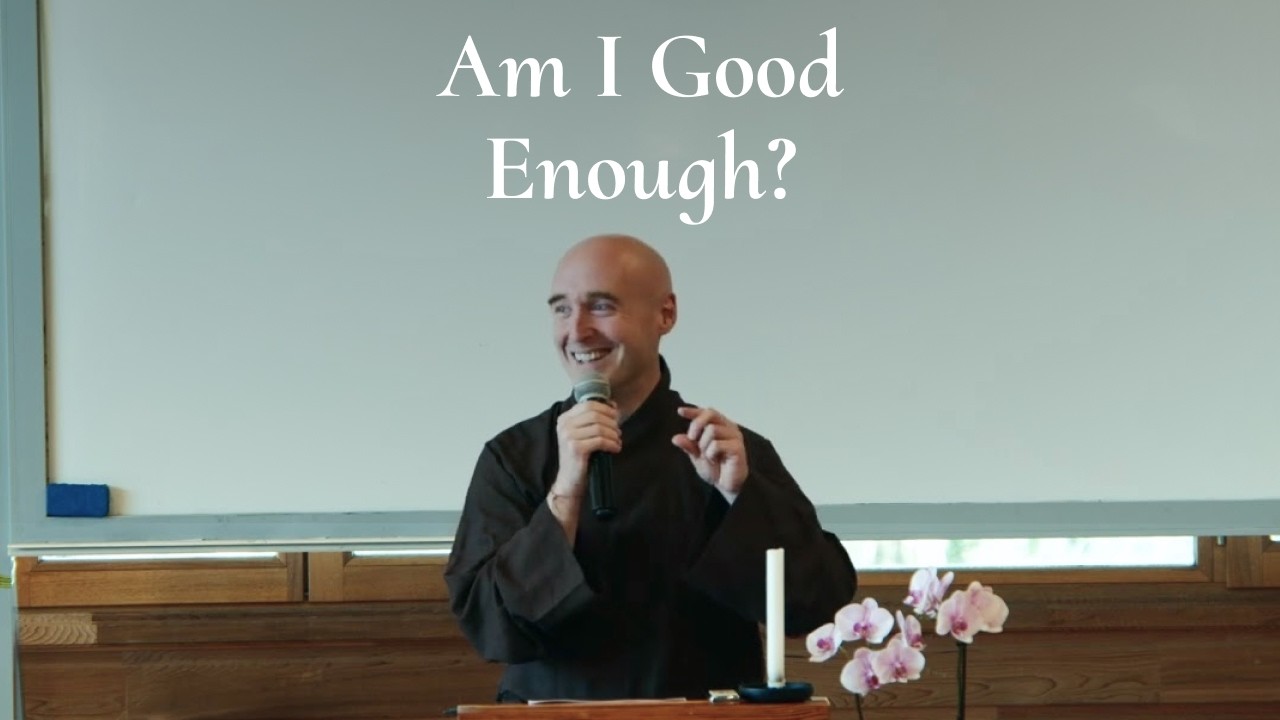
[2:46] retreat. Am I good enough?
[2:50] So tell me,
[2:52] are we good enough?
[2:56] All right, the dama talk is done.
[2:59] I think we can go out and hang and
[3:02] chill.
[3:06] You are correct.
[3:08] We are good enough. I am good enough.
[3:10] You are good enough.
[3:13] Just a disclaimer. Um
[3:18] if I cry in this dharma talk it is
[3:21] because I am going through a process of
[3:23] grief. My father died uh 58 days ago and
[3:29] uh it's been very challenging
[3:33] on the first day of our retreat in the
[3:36] first evening of sitting meditation with
[3:39] all of you.
[3:41] um
[3:43] immense pain for the first time I've
[3:46] ever experienced a rise in my chest
[3:50] and
[3:52] I think it was uh brother Baang chanting
[3:55] the evening chant and I wanted to leave
[3:59] the meditation hall
[4:02] but uh I heard the words of my teacher
[4:06] saying that when you suffer you need to
[4:08] stay you need to stick with the
[4:10] community you me to stick with uh the
[4:13] practice
[4:15] and it's linked to something that is
[4:18] formal for me because uh I found out my
[4:23] dad had a stroke when I was leading a
[4:27] transmission ceremony and it was a very
[4:30] s um it was a very sacred moment. So
[4:35] something that was so sacred that was
[4:37] happening uh in my own life and in the
[4:40] community setting and then in another
[4:43] place in another land my father was
[4:47] dying and uh I didn't I didn't know that
[4:51] that was happening. So, every time I'm
[4:54] in maybe for the next months or year,
[5:00] whenever I'm in a setting that is a
[5:03] little bit more formal, this kind of
[5:06] pain comes up. This kind of grief comes
[5:08] up.
[5:11] But I've learned to grieve in action.
[5:13] I've learned to let the pain and let the
[5:17] agony and the sorrow have its place
[5:22] and let it process within the embrace of
[5:25] um many human beings and to learn to be
[5:29] uh vulnerable and learn to be truthful
[5:32] to things that comes and goes and not
[5:38] being imprisoned by it. Um, I learned
[5:42] this from about
[5:46] four years ago already when our teacher
[5:49] transition and passed away and I wanted
[5:52] to just stop and do nothing and just and
[5:56] just stay within pain.
[5:59] There's something about pain that I
[6:01] like. There's something about sorrow
[6:04] that I I get attached to. And it
[6:08] explains why I I like really sad music.
[6:11] Some Sam Smith, some Adele.
[6:14] I love some of those. Um, and a lot of
[6:19] Vietnamese melody has a lot of
[6:21] tenderness and sorrow in it because it
[6:24] comes from also the experience of a
[6:26] nation, an experience of country that
[6:29] have gone through so much um oppression
[6:33] and war and identity.
[6:37] So a part of my upbringing is also
[6:41] clicked to a lot of sorrow
[6:45] and uh now that it activates more in my
[6:49] own personal lives that uh I'm learning
[6:52] to
[6:55] to be enough with it and and not seeing
[6:58] that it's it's not a weakness in a way
[7:02] as well as I don't want to be attached
[7:04] to it. I I don't want to cling to it.
[7:07] It's a reality but it's not my whole
[7:09] truth.
[7:11] And that's why I asked us uh am I good
[7:13] enough? And this is a very good
[7:16] question. I know brother Baang invited
[7:19] all of us to
[7:21] kind of like ponder on this coan as we
[7:26] would say in the Zen language. A coan is
[7:29] something you chew, you digest.
[7:32] You don't find the answer right away. It
[7:34] may seem very very clear. Yes, I'm good
[7:36] enough. Why I'm not good enough?
[7:39] But to understand the depths of what it
[7:43] means to
[7:45] to feel that. So I was sitting this
[7:48] morning
[7:50] and reflecting
[7:52] there are moments I do feel really good
[7:54] enough and there are moments
[7:58] I don't. And I'm sure all of us we go
[8:01] through this process and we all go
[8:03] through these experiences.
[8:06] And
[8:08] for me
[8:12] the problem is not it's not in the
[8:15] knowing it. It is sometimes remembering
[8:19] and believing it and having faith to
[8:23] oneself that
[8:25] there are so much good potentials in me.
[8:30] And in Buddhism,
[8:32] we speak about um hindrance
[8:37] that that becomes obstacles for us to
[8:41] realize our understanding, our
[8:44] awakening, our enlightenment.
[8:48] And these hindrance I I also feel is
[8:51] connected to us seeing
[8:53] our own truths.
[8:56] And in Buddhism, we always have to
[9:01] learn the dharma with a very open and
[9:04] skillful mind because here we're asking
[9:08] you, are you good enough? Which is
[9:10] talking a little bit about the self?
[9:13] But in the heart sutra that we chanted
[9:15] last night before our trans before our
[9:18] recitation, we say that there is no self
[9:21] and we are empty.
[9:24] So in the teachings of the dharma, the
[9:28] teaching it is directed to help us touch
[9:32] a liberation, to touch a freedom, to
[9:35] touch a awakening.
[9:39] So the dharma has to always be looked at
[9:43] in a way what is it addressing?
[9:46] So, in the theme for us young people,
[9:52] I'm over the age of wake up, but I don't
[9:55] look like it, right?
[9:57] Asians don't raisin.
[10:01] You guys ever heard of that? No. You
[10:03] never heard of that? Asians don't
[10:05] raisin. Okay, maybe it's an Asian thing.
[10:07] I'm looking at my Asian community.
[10:10] That's ours. Um
[10:18] there's some beauty in um in
[10:23] understanding that um there is something
[10:26] to be proud of in each and every one of
[10:30] us.
[10:33] In today's um modern world, we are
[10:37] bombarded by sense impressions. What we
[10:41] see, what we hear, what we smell, what
[10:43] we taste,
[10:45] um and our consciousness, what we are
[10:47] being surrounded by. And all of these um
[10:51] we call them the windows of our being.
[10:54] And when the window is open to
[10:56] everything with no filter with no guard
[11:00] then our mind becomes overwhelmed and
[11:05] our perceptions and our own projections
[11:08] towards our self, towards others,
[11:11] towards our parents, our loved ones, our
[11:14] community. It it gets flavored by all of
[11:18] these impressions.
[11:22] So a practitioner
[11:24] shines the light of awareness to our
[11:28] senses that we open to the world.
[11:32] What we see, what we taste, what we
[11:36] smell, what we feel,
[11:39] this is where it impacts our mind
[11:42] consciousness, our store consciousness.
[11:45] Brother Action spoke about the forming
[11:49] of the mind and how we relate to the
[11:52] inner world and the outer world. And as
[11:56] a practitioner,
[11:57] we we have the the light which is our
[12:02] awareness to see to
[12:06] to have the ability to say yes, watching
[12:10] this
[12:12] is sewing these seeds in me. It is
[12:16] energizing me or it is a toxin for me.
[12:20] And we have to have the courage to to
[12:24] ask ourself is this healthy
[12:29] and sometimes we don't know and we know
[12:31] later. Sometimes we experience it and we
[12:34] get the insight from going through those
[12:37] journey. For example, if we've never ate
[12:40] a hot chili pepper and we come to the
[12:44] dining table and it says spicy
[12:48] and but we don't know what our our taste
[12:50] bud level is yet. So we experience it
[12:54] and we touch suffering. Okay, this is
[12:55] too much.
[12:57] And sometimes we have to go through
[12:59] these experience. We have to suffer in
[13:02] order to have insight, in order to have
[13:05] the um experience.
[13:10] And sometimes
[13:12] we we are told about suffering. We are
[13:14] told about the pathways that lead to
[13:18] suffering. But we we still want to
[13:21] experience it. We still want to go
[13:23] through it. That's your experience. I
[13:25] want to feel it for myself.
[13:30] And we can all check in with oursel how
[13:32] we go through these journeys. And
[13:34] sometimes
[13:37] our own self
[13:39] is we're too proud. We're too prideful
[13:42] to also listen to others friends
[13:45] sharings.
[13:47] And this is where we also learn to open
[13:51] our hearts, open our mind to see that
[13:54] the other person's journeys are also our
[13:57] journey.
[13:58] I've been in the monastery since I'm 13.
[14:03] My high school, my university, my
[14:06] college is Plum Village.
[14:08] And I can proudly say that I'm very rich
[14:12] with a lot of experience.
[14:15] And a lot of these experience is from
[14:17] listening. It's from being with people.
[14:21] It's from experiencing your journey,
[14:24] experiencing your experience in life.
[14:29] And a lot of the
[14:32] the knowledge that I have been able to
[14:34] cultivate it is through
[14:38] individuals
[14:41] insight and intellectual pro um
[14:44] intellectual understanding that they
[14:46] they offer to themsel and to the
[14:49] community.
[14:51] And sometimes I I have gained the
[14:54] insight enough that I know I don't need
[14:56] to go down that path
[14:59] because I c I can see the suffering in
[15:02] the other person
[15:06] and this is um a interbeing practice and
[15:10] I hope that we've experienced it in the
[15:12] last seven days together through our
[15:14] sharings through our circles when we
[15:17] listen to someone else's experience.
[15:20] What does that bring up in us? Can we
[15:23] feel their excitement, their joy, their
[15:27] wonders? Or do we get jealous of that?
[15:31] Or do we start to compete? Did I feel
[15:33] that? Did I touch that?
[15:38] That is where the human error comes in.
[15:42] The competition.
[15:44] We've been trained to compete. our
[15:46] report cards. A plus, B plus, C. I was
[15:50] always in the C and B's. That was my
[15:52] area. Once in a while, I get an A and I
[15:57] would I would flag it. I would show off,
[16:00] but we've been we've been primed to
[16:03] compete.
[16:05] So, in a retreat, I don't know if you've
[16:09] competed among each other. Who was more
[16:12] who was more zen?
[16:16] Who was more happy?
[16:19] Was my posture
[16:21] in a way that others can can see that
[16:25] I'm doing well?
[16:27] And I'm saying this not as a criticism.
[16:30] I'm just saying it as a human nature.
[16:32] I'm just saying it as a tendency that we
[16:36] have we have
[16:40] we have learned
[16:42] and some of it you will you will
[16:44] discover some of the tendency it has it
[16:47] goodness and some of it it has its hook
[16:51] and is um its limits for us to to be in
[16:56] touch with our ourself.
[17:00] So when we
[17:03] ask the question am I good enough?
[17:07] It is not a judgment.
[17:09] It is to reflect and to see am I in
[17:13] touch with all of the qualities that is
[17:16] inside of me. Can I honor everything
[17:20] that is existing in the here and now?
[17:25] I have learned to be happy. I have
[17:28] learned to cultivate joy.
[17:30] I've learned to cultivate happiness
[17:34] like really learned to do that not as
[17:38] not as a a wishful thinking but as
[17:41] really sitting down and really feeling
[17:44] like I am freaking lucky.
[17:48] My ancestors have survived. They have
[17:50] struggled. I have a life that they have
[17:53] they have never experienced.
[17:56] I am darn lucky. And can I touch that
[18:00] truth?
[18:02] I have tasted food that many of them
[18:05] would never taste in this lifetime. I
[18:08] have heard language, seen culture, seen
[18:11] the beauty of humanity that none of them
[18:14] have ever experienced.
[18:17] They were always surrounded by fear,
[18:20] by
[18:22] surviving,
[18:24] by death, by sorrow.
[18:27] All of us, we are living in peace,
[18:30] right?
[18:32] We don't have to be afraid
[18:35] of a bomb falling,
[18:39] of being shot in this moment, in this
[18:42] reality.
[18:45] We know that there are places, there are
[18:46] areas that they don't have that peace.
[18:51] They don't have that safety.
[18:54] They don't have this kind of community.
[18:59] And can we
[19:01] touch that? And can we feel that and and
[19:06] make it this is a moment of happiness.
[19:13] This is a truth
[19:15] and this is where the dharma
[19:18] of dwelling happily in the present
[19:21] moment
[19:23] lands and let us live deeply
[19:27] this moment that we get to experience.
[19:33] There's a there's a gata in
[19:38] in the sutra from the Buddha's time and
[19:41] it says um
[19:45] death comes unexpectedly.
[19:48] Uh we cannot bargain with it
[19:52] and uh most of us are young so we we we
[19:56] don't think about that too much. Maybe
[19:58] in especially for those of us who are
[20:00] growing up who are living in the west
[20:04] because our safety is not uh threatened
[20:07] in that way and so we we we
[20:11] project our life in a different uh in a
[20:15] different manner in a different way but
[20:18] in the last 6 months uh in our community
[20:22] we've experienced uh many deaths I think
[20:25] plum village we hope we had to hold four
[20:28] funerals in the last 7 months within our
[20:31] monastic order and and uh in my own life
[20:35] with my my own father
[20:38] and
[20:41] it's true
[20:43] death comes very unexpectedly.
[20:47] We can meditate on impermanence. we can
[20:52] touch. The truth of um of the nature of
[20:57] life is that we're all subject to
[21:01] to growing old, to getting ill, as well
[21:05] as to dying, and to letting go. Letting
[21:08] go of our loved ones,
[21:11] letting go of the objects that we hold
[21:14] dear to our hearts,
[21:16] as well as letting go of our self.
[21:21] So in
[21:23] the meditations of impermanence
[21:26] is not to scare us
[21:28] but it is to sharpen our
[21:32] awareness of the miracles of lives
[21:37] to to the miracle of the joy that uh we
[21:42] can touch
[21:45] as well as to hold and honor the pain
[21:48] and the sorrow.
[21:52] And the beauty is that you don't have to
[21:54] get rid of one.
[21:58] When I was a young novice,
[22:00] I
[22:02] I was very idealistic
[22:05] and I wanted to be a successful monk
[22:12] and that meant I had to be happy all the
[22:14] time.
[22:16] I was happy probably 95% of the time,
[22:20] but there were moments where I do touch
[22:24] a particular
[22:27] um pain or suffering and sometimes I
[22:31] don't even know where it comes from.
[22:36] Maybe some of you have listened to the
[22:38] podcast the way out is in so you know
[22:40] these stories already. But just one of
[22:44] it for me was like self-worth.
[22:48] Self-worth was something that I was
[22:50] always searching for.
[22:53] I'm already a small person, so I was
[22:55] really afraid of not being seen.
[22:59] And then growing up in Canada, um, being
[23:02] accepted, having a voice,
[23:06] being seen as equal.
[23:10] I spoke English pretty well, but they
[23:12] put me in ESL class, English as a second
[23:15] language. I was like, hm, this is
[23:18] actually my first language.
[23:22] And so discrimination, right, comes and
[23:24] and and and uh puts you in a box and
[23:28] then your journey is like, wait, I got
[23:30] to be good enough to get out of this
[23:32] class to be seen. To be seen, just to be
[23:35] seen.
[23:37] And so I carried these um these wounds.
[23:39] I carried these experiences. I come into
[23:42] the monastery
[23:44] where majority of everyone is much more
[23:47] compassionate,
[23:49] much more um kind and present.
[23:53] But still
[23:56] this this reality of like am I good
[23:59] enough though? Am I being seen?
[24:04] Will I be accepted?
[24:07] And I think each and every one of us we
[24:10] we hold these layers inside of us
[24:14] because love is a natural
[24:18] food that we all need.
[24:22] Love is to be seen. It is to be
[24:24] understood.
[24:26] It is to be accepted.
[24:29] Doesn't matter what culture we are from,
[24:31] what religion we are brought up in, what
[24:34] family, what status we are rich, we are
[24:37] poor.
[24:40] That is a truth.
[24:43] That is a truth that there is a longing
[24:46] to be loved.
[24:49] And that's a beautiful truth as well as
[24:52] a scary truth.
[24:55] Some of the wise elders they say that
[24:58] that longing
[25:00] that love we call it the original fear
[25:04] it comes from the moment we are born we
[25:08] exist without our mother that embedical
[25:12] cord is cut that's an action of
[25:15] separation
[25:17] that's an action of survival
[25:20] we all had to breathe our own breath
[25:24] we all had to find our own nutrients.
[25:28] That was a moment of
[25:32] independence
[25:34] in a historical dimension.
[25:40] We call it the original fear,
[25:43] the original desire
[25:46] to be loved.
[25:50] And what does Buddhism
[25:53] offer us in this question, in this
[25:56] search?
[26:00] It is that
[26:02] yes, it is true we have that need, that
[26:06] wish to be held, to be seen.
[26:12] It's easy when it is being advertised
[26:15] that it's going to be given to us
[26:17] outside of us.
[26:19] But in the dharma, in meditation,
[26:23] in Buddhism, it tells us that love
[26:26] already exists.
[26:29] You have the capacity
[26:32] to see and to feel
[26:35] your own worth,
[26:37] your own beauty, as well as to recognize
[26:42] and embrace your own shortcomings,
[26:45] pains,
[26:47] habits,
[26:49] scars, whatever we want to call it.
[26:54] Because inside of us is infinite
[26:57] opportunities
[26:59] and the hindrance blocks us from seeing
[27:01] that. The first hindrance in the world
[27:05] that
[27:06] occupies our mind in the search
[27:11] it is uh desires sensual desires
[27:17] craving.
[27:20] Desire here is not the aspiration. It's
[27:23] not the goal that we we set forth for
[27:26] our own um our own journey as a human
[27:30] being, but is it it is a desire that
[27:35] that is instant but maybe not really
[27:38] healthy.
[27:39] Instant noodle is really good. I love my
[27:42] MSG. I need a hit of it from now and
[27:45] then, but I know it's not fully healthy.
[27:50] All right. instant coffee.
[27:53] But we know whole food is better, right?
[27:56] We know that something that we plant, we
[27:59] tend to organically
[28:01] has more nutrient to ourself, our whole
[28:04] being.
[28:06] So there are desires
[28:09] that that pose us away from who we who
[28:13] we see within oursel.
[28:17] sex cell, appearance cell.
[28:21] We we have discovered that advertisement
[28:24] there's a whole science behind it. How
[28:27] to hook all of us. There's a bait and
[28:31] that bait is to tell us that we're not
[28:33] enough. Do this, you'll be better. Come
[28:37] to a retreat, you'll be better.
[28:41] Sometimes we also hook you also.
[28:47] There was a question about capitalism
[28:49] right in uh in the question and
[28:51] response.
[28:53] I think we're also influenced by some
[28:56] capitalism.
[28:58] But we have to unlearn all of this. We
[29:01] have to also see that um
[29:05] that there is a
[29:08] there are desires that are wholesome
[29:12] and that there are desires that pull us
[29:15] into the pit of hell.
[29:19] It makes us um lose our own selfworth,
[29:24] our own identity.
[29:27] The journey of coming home, we probably
[29:29] heard these words. I have arrived. I'm
[29:31] home
[29:33] again and again and again. Every retreat
[29:35] you come to in the Plum Village
[29:37] tradition, we will remind you of that
[29:41] because coming home is already healing.
[29:44] Looking for our identity, knowing who we
[29:48] are, being at home in our skins, being
[29:52] at home in our language,
[29:55] being at home in our culture.
[30:01] Me finding the capacity to speak
[30:04] Vietnamese
[30:06] was me finding my selfworth.
[30:11] Me knowing how to cook fried rice was me
[30:14] finding my belonging in my heritage.
[30:20] And these are the journey that I went
[30:22] through and I had to unlearn. I had to
[30:24] fight in a way. I had scars
[30:29] going to I remember in middle school
[30:32] um bringing food
[30:35] has a particular smell being judged by
[30:38] it
[30:41] and then fearing it fearing your own
[30:44] identity
[30:47] and here I've learned to
[30:50] unlock myself unlearn and to see the
[30:54] beauty
[30:56] the culture the worth.
[30:59] So coming home is a journey. Having that
[31:02] desire to be in touch with who I am,
[31:06] being in touch with who you are is not
[31:08] just for you. It is also for your
[31:11] ancestors.
[31:13] It is for your descendants.
[31:16] And your descendants are not your
[31:17] children alone.
[31:20] As long as I am a monk, I won't have
[31:22] biological children.
[31:25] But I have a nephew. I have nieces. I
[31:28] have cousins. And I'm going to be one
[31:30] heck of a good uncle.
[31:32] And I'm going to show my my nephew and
[31:35] nieces who are Vietnamese, who live in a
[31:39] world that is dominated by the English
[31:42] language
[31:44] that there is beauty in our culture as
[31:48] well as there is beauty in speaking
[31:50] English.
[31:52] But that I don't have to do so much.
[31:56] I'll show the other side.
[31:58] Speak these words, my child. This is how
[32:01] you say yes in Vietnamese.
[32:04] This is how you meet and greet a monk in
[32:07] the Vietnamese in the Vietnamese culture
[32:10] because heritage is also a love
[32:13] language. It embraces and it carries our
[32:18] our roots. Our roots don't belong in a
[32:22] destination only.
[32:25] When we say I have arrived, I am home.
[32:28] It is because we are free. Wherever we
[32:31] go,
[32:32] wherever we find oursselfves,
[32:36] we hold that truth. We hold that beauty
[32:41] of who we are and what we carry.
[32:47] in the last um two years
[32:50] whenever somebody asks me where do I
[32:52] come from I always say I'm from Vietnam
[32:57] it's taken me 34 years to arrive to say
[33:01] that
[33:02] for the longest time I've I've always
[33:04] said I'm from Canada
[33:06] and there was a pride there was a
[33:10] also a a superiority complex there I
[33:16] felt more superior ier than my own
[33:18] heritage. I'm from Canada.
[33:22] That's that's the power of my passport.
[33:29] And I've gone through a decolonizing of
[33:31] my mind, of my own self, thanks to a
[33:35] trip in Fiji
[33:37] and in Africa where I saw that they held
[33:44] their endurance and their resilience not
[33:47] with pain but with songs and rhythm and
[33:51] beats and with power. When I was in
[33:55] Tanzania,
[33:57] I cried when I listened to a young
[34:00] activist spoke about her non-fear
[34:05] of being at the front line to protect
[34:09] her village,
[34:11] not with hatred, but with the seed of a
[34:15] warrior. Because we know how to love,
[34:17] she said. For us, activism is not a
[34:21] career. Activism is a heritage. It is a
[34:25] culture that we have received that we
[34:28] have seen that the earth is our home.
[34:30] The trees are our teachers. The river is
[34:34] our life.
[34:37] Our existence is a nutrient to the
[34:40] earth. When we die, we become the earth.
[34:45] I've never heard someone speak with such
[34:49] clarity
[34:51] and such power and such joy.
[34:56] And I really touched the resilience and
[34:59] not to be drowned in pain. I think and I
[35:02] speak this from my own experience. This
[35:04] is my truth. Maybe not your truth. I
[35:08] feel that in the west sometimes we
[35:11] we we let we let suffering just be
[35:14] sorrow
[35:16] but not let suffering be a beat and a an
[35:19] anthem so that we can find the courage
[35:23] and the the energy to march forward.
[35:27] But when I was in these lands and seeing
[35:31] these people uphold themselves, holding
[35:34] their wisdom, holding their culture
[35:37] unapologetically,
[35:39] I was like, God, I need that
[35:44] and I need Plum Village as monastic also
[35:47] to hold that front line. There's a
[35:50] beauty in our monastic culture.
[35:54] I used to also say, "Oh, we got to
[35:56] westernize this." Actually, no, no, no.
[35:57] Let's not westernize it. Let's let's
[36:00] bring essence to it. Let's bring beauty
[36:02] to it. Let's bring understanding to it.
[36:07] There are elements that we transform, we
[36:10] make it blend, we make it harmonize,
[36:13] but we don't lose who we are. We don't
[36:16] lose our identity.
[36:18] And as a living tradition, we continue
[36:21] to evolve. We continue to bring in
[36:24] different
[36:26] culture into the fold of the tradition.
[36:30] And I think we are living in an era of
[36:33] globalization.
[36:35] We're luckier than a lot of our
[36:37] ancestors.
[36:39] Maybe some of us is the first in the
[36:42] line of our of our genetic ancestors
[36:46] that you've touched Buddhism. You've
[36:47] touched a wisdom all the way from the
[36:49] far east
[36:51] and it's thanks also to suffering.
[36:54] Why is Plum Village here? Because of
[36:56] suffering.
[36:59] Because of oppression, colonization
[37:02] and war
[37:04] that that is the pain and the fruit is
[37:08] Plum Village exist.
[37:12] And can we celebrate that? Yes. as well
[37:16] as can we see and understand the pain so
[37:21] we don't repeat the same mistakes.
[37:25] Absolutely.
[37:27] We have to put that into our careers. A
[37:32] career of not jobs but a career of
[37:35] humanity.
[37:37] A career of creating a culture
[37:40] of love and understanding.
[37:45] This, my friend,
[37:48] is the dance in Buddhism between pain
[37:51] and joy.
[37:54] No mud and no lotus.
[37:58] When we see the pain,
[38:02] we have the right
[38:04] to embrace, to recognize.
[38:07] Anger shall come.
[38:10] Frustration,
[38:13] agony,
[38:15] that is the mud. But anger
[38:19] when it is activated,
[38:21] if you look deeply into anger, you see
[38:24] there's love there. Why are you angry?
[38:28] Because you are witnessing something is
[38:29] wrong.
[38:32] Therefore, anger arises.
[38:35] But the wise ones say anger as a fuel,
[38:39] as an energy
[38:41] shall also lead to more hatred, violence
[38:45] and pain.
[38:48] So the meditator
[38:50] sees anger as a bell of mindfulness and
[38:53] brings up
[38:55] compassion
[38:57] to hold oneself.
[39:02] There's a fierce compassion. There's a
[39:05] way of holding and looking.
[39:08] Compassion is not accepting the other
[39:12] person's wrongdoing and becoming
[39:15] like friends with them. I have a lot of
[39:18] people that don't like me
[39:21] and uh
[39:25] I don't like them,
[39:30] but I don't demonize them and I don't
[39:34] make them and I'm practicing to not make
[39:38] them an evil person in my own heart cuz
[39:41] that's toxic.
[39:43] That will leak. that will leak into my
[39:48] other relationships
[39:51] into uh
[39:54] my way of being. That's why our teacher
[39:58] one of his insights that he practiceh
[40:02] insight has to be practiced. Insight is
[40:05] not enough if it's just a view. Insight
[40:08] has to be practiced.
[40:11] And his insight is humans are not our
[40:13] enemies.
[40:16] our enemy.
[40:18] It is the root of ignorance. It is the
[40:21] discrimination.
[40:23] It is the fear. It is the wrong views.
[40:27] Dehumanizing
[40:29] othering ourself and others. These are
[40:33] the roots.
[40:36] The roots to see and to unlock. And when
[40:40] you see that that person it is being
[40:42] moved by those pain and those wrong
[40:46] views,
[40:48] you see them as a human being that is
[40:50] full of wrong views. Something something
[40:54] happens in your heart. You will look at
[40:57] them, you will see them still as a human
[40:59] being full of ignorance
[41:02] and how unfortunate they are of not
[41:05] having good friends, a good society that
[41:09] have shine light to them.
[41:12] And it's very unfortunate because their
[41:14] whole life with this view they will
[41:17] suffer and they will continue to make
[41:19] others suffer.
[41:22] And this is the the eye of the bodhic
[41:27] satta in seeing that that they have
[41:30] these
[41:32] these um these ignorance
[41:36] which lead to wrong desires.
[41:40] A a bodhic sadva
[41:43] bodhicattva means a being with great
[41:46] aspiration
[41:47] and awakening. And all of us we are
[41:51] bodhic sattvas.
[41:52] Maybe that seed is still a sesame but
[41:56] it's there. And maybe for some of us is
[41:59] uh it's a peanut now after seven days.
[42:04] Maybe for some of us is become a tree
[42:07] even.
[42:09] But we all have this inside of us. And
[42:12] some bodhic sattvas will go and meet
[42:16] the will go and meet the person that is
[42:20] causing suffering
[42:22] and has the ability to see them to speak
[42:26] to them and to listen to them.
[42:30] Listening is an incredible
[42:33] skill set. Listening is communication.
[42:37] Listening is an act of love. It is an
[42:41] act of almost unlocking something.
[42:47] When we listen and when we are felt that
[42:50] we are being listened to as a speaker,
[42:56] your words will be shared in a way that
[42:59] has a more awareness because you feel
[43:02] you're not speaking to a wall anymore.
[43:04] You feel that you're not speaking to a
[43:07] distraction, but you're speaking to
[43:09] those who are putting their heart at the
[43:13] front line to hear you.
[43:16] Listening is in our in our our belief.
[43:22] It is the key to reconciliation.
[43:25] It is the key to change.
[43:30] our teacher um
[43:34] was a Buddhist monk, an activist as well
[43:38] as a visionary
[43:40] and um he he used to go to a lot of
[43:43] conferences and during the um the
[43:46] American war. Maybe some of us we know
[43:49] it as the Vietnam War.
[43:52] But he saw that at the conference it was
[43:54] all ideas. It was just it was just words
[43:59] and
[44:02] and of course he played a part in
[44:04] offering his wisdom in in his sharing to
[44:08] speak truths.
[44:11] But do you know why Plum Village
[44:14] emphasized retreats
[44:16] for him? This is a conference.
[44:19] This is a peace conference.
[44:22] These seven days that you just
[44:24] experienced is a peace conference.
[44:28] It is for you to touch what being in
[44:31] community is.
[44:33] For you to learn to listen to someone
[44:35] you've never met and to open your heart
[44:39] to that person's experience.
[44:42] You touch love. You touch sorrow. You
[44:45] touch joy.
[44:47] That becomes your trust in your own
[44:50] humanity.
[44:52] into your belief that peace is freaking
[44:56] possible.
[44:59] We got to give it a chance.
[45:01] We have to allow ourself to cultivate
[45:05] it.
[45:07] And it's not through just the talks from
[45:10] the monks. It is from us standing in
[45:13] line
[45:16] serving
[45:19] seeing the other person not not having
[45:22] enough
[45:23] sharing cutting a piece of bread for the
[45:25] other person. They are simple act but
[45:29] that activates
[45:34] the collectiveness of our nature.
[45:38] We we are we are beings of community.
[45:43] It is only within the last
[45:47] era of um
[45:51] what is that word I'm looking for
[45:54] the factory and the industry uh
[45:58] say that again the industrial revolution
[46:02] that we have
[46:05] we have um
[46:07] glorify
[46:10] individual success us.
[46:15] But by nature, we we know how to love.
[46:19] We know how to share. We're actually
[46:22] very very
[46:24] empathetic.
[46:26] Empathetic, meaning having compassion
[46:28] for one another, right? Yes. We're very
[46:31] empathetic. We're actually very
[46:33] empathetic.
[46:35] And I've seen this. I've seen this in
[46:38] this community.
[46:41] I've seen this in hardship.
[46:44] I've seen this with true friends.
[46:48] When there someone is in pain and
[46:51] suffering, we do have the power to let
[46:55] go of everything and to arrive as
[46:57] suffering,
[46:59] to arrive at someone's pain. Even if we
[47:03] don't have the answer,
[47:06] we come just to show up, just to say, "I
[47:09] know you're in pain."
[47:12] Simple.
[47:14] That's it. It is our our it is our
[47:20] our world that that we have to keep
[47:23] unlearning. And I and I speak about
[47:25] myself because there's so much
[47:27] projection and there's so much demand.
[47:31] Brother Fapu, what is your take on this?
[47:33] I don't know. I absolutely do not know,
[47:37] but give me a bit. Give me give me some
[47:40] deep breath and that means weeks and
[47:41] months.
[47:43] Now we live in a world where everything
[47:45] needs to be instant.
[47:48] We, you know, messaging, we we write
[47:51] things, response have to be right away.
[47:56] Sometimes
[47:58] answers take time to ripen.
[48:02] Our
[48:04] our
[48:05] insight takes time to know what to do,
[48:09] what not to do.
[48:12] So that is why in the art of Zen,
[48:17] stopping is really important. Stopping
[48:20] it doesn't mean you're not doing
[48:21] something but stopping it means that we
[48:25] stop searching for something outside of
[48:27] you.
[48:29] Even when we're asked for a help,
[48:33] okay, I got to find a solution.
[48:35] We get really restless.
[48:38] We we we go into this this habit energy
[48:42] of society.
[48:49] There's a lot of wisdom also inside of
[48:51] us.
[48:54] Calm down. Breathe.
[48:58] Let your mind consciousness.
[49:01] Store consciousness
[49:04] awaken.
[49:06] Cuz we our wisdoms is not ours alone.
[49:10] Our wisdom come from our blood
[49:12] ancestors,
[49:14] our parents. Even if our parents may not
[49:17] be some of the most insightful people,
[49:21] but they do have wisdom that they have
[49:23] shown and given to us. Then our
[49:26] spiritual,
[49:28] then our friends,
[49:31] our land
[49:34] and all of this, it is present.
[49:37] And when we can trust and we can listen
[49:40] a respond will come.
[49:45] So stopping when we speak about stopping
[49:46] in Zen is not about stopping action. It
[49:50] is stopping from the chase. The chase of
[49:56] of finding a quick solution.
[50:00] It's because we find quick solution we
[50:03] we we lose our true identity. we forget
[50:07] who we are.
[50:10] So the first I'll just name them because
[50:13] I've touched most of them already. The
[50:15] first hindrance is sensual desires.
[50:18] Second hindrance is our ill will. It
[50:21] will such as our anger, the resentment
[50:24] that we can carry, aversions, the hatred
[50:28] that will block us that will block our
[50:30] hearts
[50:32] from being in the world as an open
[50:35] person to experience also all of the
[50:41] other wonders that are there.
[50:43] The third one
[50:46] is dullness is uh drowsiness or the lack
[50:50] of clarity sometimes as a numbness.
[50:54] In other Buddhist language they call it
[50:57] laziness but we have a lazy day in plum
[50:59] village. So so we see the wisdom in our
[51:03] laziness in today's modern world where
[51:07] we are we are we are humans of doers not
[51:11] beers. We don't know how to be. We just
[51:14] know how to do.
[51:16] And um this hindrance it is.
[51:21] Yeah. I I think I don't have to speak
[51:23] much about it because uh I find myself
[51:26] in it also. The the the lack of um of
[51:33] freshness, the lack of energy.
[51:36] Um, we may drown in our present moment
[51:40] and then drown into our screen time,
[51:43] drown into just filling up the void.
[51:47] Filling up the void. And the more we
[51:49] fill fill up the void without clear
[51:53] intention.
[51:54] We will we will lose our own in the
[51:58] Buddhist language we call it we lose our
[52:00] own bodhicitta. We lose our mind of
[52:03] love, our mind of service, our mind to
[52:06] offer to do.
[52:09] So do dullness is one of the hindrance
[52:12] that uh we can reflect in and that's
[52:15] where there are elements in the Zen
[52:18] school where discipline plays a part in
[52:20] it. Discipline also if it is too extreme
[52:26] it also becomes a problem.
[52:29] discipline. Um,
[52:32] in our language, our teacher always
[52:34] using the language, how do we water the
[52:37] right seeds in us? How do we water the
[52:40] activities in our day that keeps us on
[52:43] track
[52:45] so that we don't lose our intentions?
[52:49] So, if we want to be
[52:52] a meditator once uh in our life outside
[52:55] of Plum Village, there got to be some
[52:58] discipline. We got to set something up
[53:01] in our schedule in our home. Make a
[53:04] corner. This is my breathing corner. It
[53:08] doesn't have to be like a a huge space.
[53:10] A little table, a candle, a pebble from
[53:14] Plum Village, a leaf from Plum Village,
[53:16] something to remind us. So, every time I
[53:19] leave the I leave the door, I go into
[53:23] the day, let me breathe three breaths
[53:26] before I leave out.
[53:29] in in my upbringing in our heritage we
[53:32] had this insight but I didn't understand
[53:34] it wasn't in the plumbage way it was
[53:37] more of an ancestral um tradition before
[53:41] we leave the house we would have to
[53:42] light an incense
[53:44] and that incense it is to tell our
[53:48] ancestors that I'm about to leave my
[53:50] safe zone
[53:52] and I'm about to venture into the world
[53:55] ancestors please watch over
[53:59] And that's how we used to do. I remember
[54:00] growing up I every morning before school
[54:02] I would light an incense but then it
[54:05] became so systematic
[54:07] and I didn't know why I did it and it
[54:09] became a little bit like a um a ritual
[54:13] which I got allergic to. So I slowly I
[54:17] cancelled it.
[54:19] But now I understand I see the beauty.
[54:23] And so these moments of like just very
[54:26] little
[54:28] details that we can activate in our day,
[54:30] a prayer, a moment of intention.
[54:35] We may need something to help set that
[54:37] intention.
[54:39] And this is where we hope in the
[54:40] retreat. We don't expect you to carry
[54:43] the whole Plum Village home. Impossible.
[54:46] Cuz you're not Plum Village at home.
[54:48] This is Plum Village. But you can bring
[54:51] elements.
[54:53] be skillful. What are the things that
[54:55] you can make it seamless but a part of
[55:00] your ritual? Because it has power there.
[55:04] And before you sleep, before you rest,
[55:08] what is something that you could do
[55:11] that can
[55:14] remind you that you just live 24 hours
[55:18] and you're about to enter into a night
[55:22] and you're about to sleep
[55:25] and that 24 hours will will fade away,
[55:28] will become a past. That 24 hours will
[55:32] die.
[55:34] for another hour to manifest.
[55:38] For some of us, it is a touching of the
[55:41] earth. It is a moment of reflection.
[55:45] It is a moment to be grateful.
[55:48] And we see this in many different wisdom
[55:51] lineage that has been handed down.
[55:55] We are very spiritual beings.
[56:00] hate to break it to us. We're all very
[56:02] spiritual beings.
[56:06] You cannot get rid of that side in us.
[56:09] And spirituality doesn't mean religion.
[56:12] Spirituality means
[56:14] the depths of interconnectedness.
[56:20] We're very ritual. Eating breakfast,
[56:22] lunch, and dinner.
[56:25] There are rituals in our life.
[56:28] But we're offering you another dimension
[56:32] to make it something to water the
[56:35] goodness in you, the mindfulness in you,
[56:38] the concentration in you.
[56:42] The bells that we've learned to listen
[56:44] here.
[56:46] That is a practice very concrete,
[56:49] very accessible, very doable. You can
[56:52] invite a sound of the bell in the
[56:54] morning, a sound of the bell in the
[56:56] night.
[56:58] Reminding yourself that I am enough.
[57:03] Reminding yourself that I have so much
[57:07] wisdom and experience
[57:10] potentials inside of me.
[57:14] Be skillful. Be an artist. When you
[57:17] leave here, find what you can
[57:22] create in your pattern in the life to
[57:25] make it uh like a necessity.
[57:29] Just like when you brush your teeth, you
[57:31] feel it cleansiness.
[57:33] And if you don't brush your teeth for a
[57:35] few days, you feel I got to do that.
[57:39] So something in the practice make it
[57:42] like that.
[57:45] I haven't sat and listened to my
[57:48] breathing.
[57:50] And there's a sensation when you
[57:52] actually do it. There's a beauty there.
[57:56] There's something that you hold.
[58:00] The fourth hindrance is restlessness.
[58:04] Restlessness. We've touched on that. And
[58:06] interesting in some in some Buddhist
[58:09] traditions
[58:10] they say restlessness and regret as a
[58:13] hindrance.
[58:15] regret because uh it locks us down. We
[58:19] we relate to the things we haven't done,
[58:22] the things we could have done better and
[58:24] that becomes a lock. We we're not
[58:28] touching the present moment. We're not
[58:30] seeing that in this moment we can live a
[58:34] way to repair and renew the regrets that
[58:37] we have made, the mistakes that we have
[58:39] made.
[58:42] Our teacher once said, "Yesterday you
[58:45] had an evil thought,
[58:47] but today you can generate a
[58:51] compassionate thought.
[58:54] You can generate a compassionate action.
[58:58] You can bring up a loving a loving view,
[59:02] a loving thought to yourself, to those
[59:05] that you hold in your hearts.
[59:08] We're not defined by our past
[59:12] only. The past have become building
[59:15] blocks, threads of the way that we are
[59:19] now. The thoughts, the thinking, the
[59:21] perceptions, the feelings.
[59:24] And the present moment,
[59:28] it unlocks
[59:29] new potential. It opens new pathways
[59:34] because this present moment will become
[59:36] yesterday later on.
[59:39] How you paint today that is
[59:43] that is your will. That is your freedom.
[59:49] Tai has said that mindfulness unlocks
[59:52] our free will.
[59:55] of free will of how we cultivate our
[59:57] thoughts, our speech,
[1:00:00] and our deeds, our actions.
[1:00:03] As we've learned, these are our truest
[1:00:05] belonging, the three karmas.
[1:00:10] And in restlessness, um
[1:00:14] restlessness comes and goes. And
[1:00:16] restlessness is um
[1:00:19] is very ninja. It's a it's a kind of
[1:00:22] collective energy of today. And
[1:00:24] restlessness seeps in the monasteries. I
[1:00:27] see it in myself. I see it in my
[1:00:29] brothers and my sisters. I see it in the
[1:00:32] the lay friends once they start
[1:00:35] fermenting in Plum Village.
[1:00:38] Fermentation meaning you've stayed here
[1:00:40] so long and like you don't know what to
[1:00:42] do. But then all these energy still
[1:00:44] comes and the restlessness also
[1:00:48] manifests.
[1:00:49] And when restlessness becomes a source
[1:00:52] of energy,
[1:00:54] we lose our our balance.
[1:00:58] A very concrete practice and I do this
[1:01:02] is slow walking meditation.
[1:01:05] Slow walking meditation is a very
[1:01:07] intentional practice.
[1:01:10] Slow walking meditation is we are
[1:01:15] actively
[1:01:16] making our steps slow down. making our
[1:01:19] actions, our thoughts, our feelings be
[1:01:22] in the motion of slowness.
[1:01:26] Mindfulness is uh awareness but our
[1:01:29] awareness comes and go. We need
[1:01:31] concentration.
[1:01:33] Concentration helps develop and sustain
[1:01:38] the awareness.
[1:01:40] So slow walking meditation could be very
[1:01:43] helpful.
[1:01:47] If those of us who are public speakers
[1:01:50] or in a team building and you need to
[1:01:53] make a presentation,
[1:01:55] you feel restless. You get butterflies.
[1:01:58] You get anxious. Your mind is creating
[1:02:01] stories. You're judging yourself before
[1:02:05] you even said anything.
[1:02:07] You're creating the outcome before you
[1:02:09] even done anything.
[1:02:13] Slow walking could be your best friend.
[1:02:16] You've prepared enough.
[1:02:19] In those moments,
[1:02:21] come back to your breathing. Come back
[1:02:23] to your steps.
[1:02:27] Bring your whole
[1:02:31] self, even the fear, even the the
[1:02:34] restlessness and the unknown
[1:02:38] and let it be grounded in your steps.
[1:02:42] And when you walk in this way, you touch
[1:02:46] I am enough.
[1:02:48] I am enough to offer
[1:02:51] the words that I need to say. I'm enough
[1:02:55] to meet the team to share the insights
[1:02:58] that I have been preparing.
[1:03:02] And that groundedness
[1:03:04] will also open up your trust within
[1:03:08] yourself, your ability to deliver.
[1:03:12] The more you start, the more you keep
[1:03:14] preparing, it leads nowhere to be
[1:03:16] honest. It leads to more fear.
[1:03:23] Yesterday uh one of our monastic sibling
[1:03:25] was on the panel and I saw him from afar
[1:03:31] um choosing the longer path to come to
[1:03:34] the meditation hall and I believe that
[1:03:37] he was practicing walking meditation
[1:03:42] to to ground himself to arrive within
[1:03:45] his body so that when he shows up he
[1:03:49] will deliver his whole presence.
[1:03:53] and his his enoughness in that moment.
[1:03:59] So I invite you to explore this
[1:04:02] practice, explore this spiritual
[1:04:05] technology
[1:04:07] and you can bring it wherever you go.
[1:04:10] You can be in a business suit and go
[1:04:13] full ninja. Nobody needs to know you're
[1:04:15] a meditator.
[1:04:17] Your breath, your step is yours.
[1:04:21] And when you show up in that way, you
[1:04:24] offer something more than the words.
[1:04:27] You're offering your presence.
[1:04:30] You're offering your confidence.
[1:04:33] Confidence here is not in the ego.
[1:04:36] Confidence here is in knowing that you
[1:04:39] can share words that you have been
[1:04:42] cultivating.
[1:04:46] And you keep learning. You keep learning
[1:04:48] and learning and learning. If I look
[1:04:51] back to my first dharma talk in 2017,
[1:04:54] I'll cringe.
[1:04:56] But I wouldn't be able to speak like
[1:04:58] this if I didn't
[1:05:00] offer those first talks in those ways.
[1:05:04] We always say trust the process. Right?
[1:05:09] The fifth hindrance is a
[1:05:14] is a practice and that is doubt.
[1:05:18] Doubt within oursel. Doubt within the
[1:05:21] path we've chosen.
[1:05:23] Doubt within our capacity of love, our
[1:05:26] capacity of
[1:05:29] of being, our careers, our decisions.
[1:05:35] It can be crippling. It can be um
[1:05:40] um energy draining. I think my my
[1:05:44] hardest moment in my monastic path was
[1:05:47] when I was doubting
[1:05:49] um I was doubting if I should stay as a
[1:05:52] monk or not and it sucked my energy. It
[1:05:55] was a vampire
[1:05:57] and it was so draining
[1:06:01] and the mind is a drainer. Once doubt
[1:06:04] come in doubt is one of the most
[1:06:06] incredible painter. It paints many
[1:06:10] different realities.
[1:06:12] many different fears. It gripples it
[1:06:15] locks into your not enoughness. The
[1:06:19] grass is greener somewhere else and it
[1:06:22] starts to paint. It starts to
[1:06:26] your it cripples oneself
[1:06:30] and doubt is also a part of us. It also
[1:06:34] comes from the
[1:06:37] questioning, the curiosity.
[1:06:40] It's like is this the right path? Is
[1:06:43] this enough?
[1:06:45] So how do we practice with this? How do
[1:06:47] we meditate with this?
[1:06:52] I think for myself the first realization
[1:06:55] is just accepting that I have doubt
[1:06:59] and accepting that uh
[1:07:02] I'm not as solid as I thought I was. I'm
[1:07:06] not as sure
[1:07:08] as I have been preparing myself to be.
[1:07:13] And what comes with that? Am I failing?
[1:07:18] Is this not working for me?
[1:07:22] Why am I suffering if I've been
[1:07:25] meditating?
[1:07:26] Is it meditation to liberate myself from
[1:07:29] suffering?
[1:07:34] And one of my insight was ah because you
[1:07:36] are meditating you know you have doubt
[1:07:39] because you are a practitioner you know
[1:07:42] that you are suffering
[1:07:45] but embracing that
[1:07:48] it hurts the pride my friend
[1:07:52] and you learn to ask for help.
[1:07:58] Asking for help is very humbling.
[1:08:04] There's a part in it. Maybe it touches
[1:08:06] humiliation.
[1:08:08] Maybe it touches a
[1:08:11] a superiority complex in us.
[1:08:15] But why do we have friends,
[1:08:18] spiritual friends?
[1:08:22] They are there to also help shine the
[1:08:24] light to reflect
[1:08:28] ourself.
[1:08:32] Learn
[1:08:35] to entrust
[1:08:38] some of your doubt to others so that you
[1:08:41] can hear it.
[1:08:44] I remember after a year and a half of
[1:08:46] struggling,
[1:08:48] wrestling
[1:08:50] to be or not to be,
[1:08:53] that is the question.
[1:08:55] Tao say that is not the question.
[1:08:58] But my question was to stay or not to
[1:09:00] stay. That was the that was the
[1:09:02] question.
[1:09:05] And in that question I had a lot of fear
[1:09:08] because that also means I'm failing.
[1:09:11] And I had the courage to ask one of my
[1:09:13] mentors who I looked up to and I said
[1:09:17] can you just listen to me for a bit
[1:09:21] and he was very generous and he said
[1:09:23] yes.
[1:09:25] And as I was sharing things that I was
[1:09:28] holding in my heart, what was very
[1:09:31] interesting was I was starting to be
[1:09:33] also shameful of what I was saying in
[1:09:37] the in the reflection of what I was
[1:09:40] speaking of my moments that those truths
[1:09:42] that I was holding on to.
[1:09:46] And then after I felt heard, my older
[1:09:49] brother looked at me and he said, "Now
[1:09:52] would you listen to me?"
[1:09:55] And I said, "Absolutely, cuz you just
[1:09:57] listened to 45 minute of me yapping."
[1:10:00] So,
[1:10:04] and um the first thing he said
[1:10:08] was a knife to my heart.
[1:10:12] He said, "You've lost faith.
[1:10:15] You've lost faith in the community.
[1:10:21] I defended it right away. No, no, no,
[1:10:23] no, no, no, no. That's a wrong
[1:10:24] perception.
[1:10:27] So, my older brother is also like
[1:10:29] Vietnamese American. So, like we grew up
[1:10:31] in North America. He and he literally
[1:10:34] told me, "Shut up, Fapoo."
[1:10:43] He said, "Listen." He looked at me. He
[1:10:45] said, "Listen."
[1:10:48] I was very humbled by that. I said,
[1:10:51] "Sorry."
[1:10:54] And as he kept speaking,
[1:10:58] everything he was saying was true.
[1:11:03] And I realize that your loved ones, your
[1:11:06] friends,
[1:11:08] they see you. They see your blind side.
[1:11:11] And they've been witnessing you. They've
[1:11:13] been watching you. And they're just
[1:11:15] waiting for that moment for you to open
[1:11:17] your heart so that you can listen.
[1:11:22] And if I didn't open my heart, then they
[1:11:24] wouldn't share it because they know
[1:11:25] you're not ready for these truths.
[1:11:29] Has you ever had deep tissue massage?
[1:11:31] It's so painful and you're like, "Oh,
[1:11:35] yes."
[1:11:37] And you know it hurts and it's unlocking
[1:11:40] something and then you can be bruised
[1:11:43] for weeks.
[1:11:45] You don't want to see that therapist
[1:11:47] anymore cuz it's painful. But that
[1:11:50] therapist just unlock all your chakras.
[1:11:58] in friendship.
[1:12:00] If you have one friend, one spiritual
[1:12:03] friend
[1:12:05] who learns and has the ability to just
[1:12:09] listen and just to shine the light.
[1:12:13] You're a very rich person. You're a very
[1:12:16] lucky person.
[1:12:18] If you have two,
[1:12:21] if you have four
[1:12:24] and this is when Ananda
[1:12:28] told the Buddha, he had an insight. He
[1:12:30] told the Buddha said like, "Buddha,
[1:12:33] I realized that spiritual friendship is
[1:12:36] half of the path." And the Buddha looked
[1:12:39] at Ananda and said, "No, it's not half
[1:12:42] of the path. It is the whole path.
[1:12:46] friendship, companionship, community, it
[1:12:50] is the whole foundation of spirituality.
[1:12:55] So in the self there is the non-self. In
[1:12:59] a community it is made of many selves
[1:13:03] but in the self there is an emptiness.
[1:13:07] What are we empty of?
[1:13:10] is everything.
[1:13:14] We are made of our ancestors. The food
[1:13:19] what I am sharing to you, they are
[1:13:22] wisdoms that have come from many
[1:13:24] generation
[1:13:25] and now they will be yours.
[1:13:28] But you can't call them yours alone.
[1:13:30] You're not the only author of your
[1:13:32] understanding
[1:13:35] because your understanding comes from
[1:13:37] also my experience.
[1:13:40] My teachers experience, my brother's
[1:13:42] experience, my sister's wisdom,
[1:13:46] my ancestors
[1:13:48] continuation of transmission
[1:13:51] as well as your direct experience to
[1:13:53] life,
[1:13:55] to the pain, to the joy. This is when we
[1:14:00] speak about nonself
[1:14:02] because we are who we are. It is only
[1:14:05] thanks to all of the non us element.
[1:14:09] That is the liberation
[1:14:11] in
[1:14:13] am I enough? Yes, because you're not
[1:14:16] alone. When you feel that you're not
[1:14:18] enough, borrow some of ours.
[1:14:22] Borrow some of the courage of your
[1:14:24] friends, your loved ones, the stability
[1:14:27] of your brothers, your sister, your
[1:14:29] companions.
[1:14:31] When you're not fresh, look at a child
[1:14:34] and see their wonder in their eyes. When
[1:14:37] you're not solid, go to the mountains,
[1:14:40] borrow the elements of the earth.
[1:14:44] When you feel that you need to be
[1:14:45] rooted, stand next to a tree.
[1:14:50] When you want to listen to melodies that
[1:14:53] is not yours,
[1:14:57] stand next to our lotus bond and hear
[1:14:59] the frogs.
[1:15:02] They will sing songs throughout the
[1:15:05] night.
[1:15:10] Are you enough? It's not about you only.
[1:15:16] You're always going to be enough. is
[1:15:18] whether you remember it or not. And when
[1:15:21] you feel that you're shallowed in those
[1:15:24] sources, you have to know that you're
[1:15:26] not alone. And this is not poetic. This
[1:15:29] is really true.
[1:15:32] Look at these maybe 100 of us sitting in
[1:15:35] this hall.
[1:15:38] People with true aspirations
[1:15:42] wanting to be
[1:15:46] a flower of truth, of beauty in the
[1:15:50] garden of humanity.
[1:15:52] And we have all impacted each other in
[1:15:55] the last eight days,
[1:15:57] seven days.
[1:15:59] We've all offered something to one
[1:16:02] another. Whether we've talked to each
[1:16:04] other or not, that doesn't matter
[1:16:06] because I've seen you. I've I've watched
[1:16:09] you walked. I've seen your joy. I've
[1:16:12] heard your laughter.
[1:16:15] I've also felt your sitting with your
[1:16:18] pain
[1:16:19] and your questions, your deep questions.
[1:16:25] And that is the net of Indra that links
[1:16:30] all of us.
[1:16:32] We need a little bit of the meditator's
[1:16:35] eye to feel that, to touch that.
[1:16:39] So whenever we feel that we are helpless
[1:16:43] and alone
[1:16:46] there's a resilience to a discipline to
[1:16:50] staying to holding
[1:16:52] like I shared that first night when I
[1:16:54] was sitting
[1:16:57] that agony that sorrow was so intense
[1:17:01] and I just said dear community hold this
[1:17:04] for me
[1:17:06] it's so much
[1:17:09] this sorrow. I just miss my dad
[1:17:12] and I just say I can't hold this alone
[1:17:18] and I you you didn't know but I was I
[1:17:22] was asking each and every one of you to
[1:17:24] hold a part of that
[1:17:27] and I felt I felt being held just by
[1:17:31] sitting there
[1:17:35] and it was incredible when I left the
[1:17:37] hall with everyone one
[1:17:40] that was lifted. I was like,
[1:17:44] that was a workout, but
[1:17:47] but I didn't do most of it.
[1:17:51] And that is also the remembering that
[1:17:55] I'm not alone
[1:17:58] and that pain is not mine alone.
[1:18:05] to support our um
[1:18:11] our question. Am I enough? There are
[1:18:15] three doors of liberation that I want to
[1:18:18] transmit to all of you. And uh it it is
[1:18:23] a
[1:18:26] it is an understanding to feel and to to
[1:18:29] to have your own insight into it. One
[1:18:33] thing that we have to know that um a lot
[1:18:36] of the the teachings
[1:18:38] they are insights that are transmitted
[1:18:41] to us but they're not yet our insight.
[1:18:45] They're are insights of of our teachers
[1:18:48] and our our wise elders.
[1:18:53] But they generously
[1:18:55] offer it to us for us to nurture to
[1:19:00] practice and for our own understanding
[1:19:03] in this wisdom
[1:19:05] to bear fruit.
[1:19:08] The first insight is
[1:19:13] the first door of liberation, a
[1:19:16] concentration to practice
[1:19:18] is that there is we are empty.
[1:19:23] Emptiness
[1:19:25] emptiness is the reality of all
[1:19:30] formations.
[1:19:32] A formation in our language is uh is an
[1:19:36] object like this flower is a formation.
[1:19:38] I am a formation. You are a formation.
[1:19:41] Our feelings are formation.
[1:19:43] They they are already there but they
[1:19:46] need conditions for it to to be to
[1:19:49] manifest.
[1:19:51] But the moment you remove the other
[1:19:54] elements,
[1:19:55] they can't exist anymore. So when we
[1:19:59] look into our own self, we know that we
[1:20:03] are made of our nonself element. Just as
[1:20:07] Buddhism is made of non Buddhist
[1:20:10] element,
[1:20:11] Buddhism has its own lineage and its own
[1:20:14] journey and each and every one of us we
[1:20:18] are constantly made of our non-self
[1:20:20] element. How we are being influenced
[1:20:25] comes from also outside comes inside.
[1:20:30] And how can this uh liberate us? It is
[1:20:35] when we practice
[1:20:39] when we practice um in in Buddhism, we
[1:20:44] we we have to honor the
[1:20:49] the we have to honor
[1:20:52] the continuation
[1:20:55] of life.
[1:20:58] Whenever you have pride, pride.
[1:21:01] If you ever have pride, whenever you
[1:21:03] have pride, don't be too afraid of it.
[1:21:06] There's a channel that you can offer it
[1:21:08] to that can help. That is gratitude.
[1:21:11] Very simple.
[1:21:13] Like I said, we we all need love. And
[1:21:16] sometimes when we we see that we've done
[1:21:18] something, we want to be congratulated.
[1:21:20] It's important to be loved. It is
[1:21:23] important to be said, thank you so much
[1:21:26] for all the hard work you've just done.
[1:21:29] And that can give us power, reasoning
[1:21:33] that offers us some
[1:21:36] um courage and and and meaning. The only
[1:21:41] reason why I'm still a monk is because
[1:21:43] of these retreats.
[1:21:45] Because I see that what I'm doing, it
[1:21:48] offers something to to people.
[1:21:52] And I do feel proud. I do feel grateful.
[1:21:57] I do feel honored.
[1:22:00] And in Buddhism, whenever these energy
[1:22:04] comes up, we know that it is not ours
[1:22:07] alone. The success of something is not
[1:22:10] ours alone. It is from so many different
[1:22:13] conditions. All of you are a part of it.
[1:22:17] And we have a we have a saying, we share
[1:22:19] the merit. So whenever ego arises,
[1:22:24] you've done something really good,
[1:22:25] someone comes and praise you, you can
[1:22:28] receive it and then you do tai chi
[1:22:32] and you offer that energy into all of
[1:22:35] your nonself elements.
[1:22:38] Thank you dear ancestors,
[1:22:43] dear parents,
[1:22:45] dear earth,
[1:22:47] this condition
[1:22:50] and it's really real. I want to share
[1:22:52] with you a story.
[1:22:55] There was a time I went to the
[1:22:58] Hermitage, which is our teachers hut,
[1:23:01] and there's a lot of excitement because
[1:23:03] that day a new book of his just came
[1:23:05] out. And uh we said, "Ty, fresh off the
[1:23:08] press. Fresh off the press."
[1:23:11] He received the book with two hands,
[1:23:16] left the party, the excitement,
[1:23:20] went into his library.
[1:23:23] in his library here. He has an altar.
[1:23:26] The first thing he did, he put his book
[1:23:30] on the altar
[1:23:34] and then he posturrated. He touched the
[1:23:36] earth three times.
[1:23:46] I was a young monk and I just witnessed
[1:23:48] him and I followed his action and as I
[1:23:53] was postrating with him
[1:23:56] without him saying anything my
[1:23:58] interpretation
[1:24:00] he was sharing the merit even though the
[1:24:02] book has in big fonts tick
[1:24:08] which is his name
[1:24:12] but it's not his alone.
[1:24:15] Where did all of this insight, all of
[1:24:18] the words come into this book? It is
[1:24:23] beyond him. It is more than him. And the
[1:24:26] first thing you do to protect and to
[1:24:29] guard your mind and your pride
[1:24:33] is you share the merit.
[1:24:38] And he turned around after three
[1:24:40] postration and he saw me and he looked
[1:24:42] at me. They said, "Let's go celebrate."
[1:24:45] How do monks celebrate and nun
[1:24:47] celebrate? Tea.
[1:24:50] It's like, "Go make Tai a good pot of
[1:24:53] hot tea." I'm like, "I'm on it, Ty."
[1:24:56] So emptiness.
[1:24:59] The second
[1:25:01] domador
[1:25:02] it is signlessness
[1:25:07] to be free from all signs.
[1:25:11] Outward appearance, our attachment to
[1:25:13] appearance,
[1:25:15] our attachment to an object and
[1:25:17] attachment to our self, to who we are
[1:25:20] today.
[1:25:22] We're constantly changing.
[1:25:25] we will be different tomorrow
[1:25:28] or our loved ones that we hold on to the
[1:25:31] friendship.
[1:25:33] Maybe some of my most painful
[1:25:37] moments was knowing an end of a
[1:25:39] friendship.
[1:25:43] I've had very good friends even in the
[1:25:45] monastic community
[1:25:47] where also our friendship had died.
[1:25:51] I've lost some friendship
[1:25:54] and some of it it's just due to
[1:25:56] conditions due to our changing that
[1:25:59] monastic may have changed their life
[1:26:02] have uh uh left monastic life and we
[1:26:06] always say oh we're always family okay
[1:26:10] but then life takes different turns and
[1:26:15] I cannot see eye to eye with that person
[1:26:17] anymore conversations are so different
[1:26:21] and uh and we lose we I've lost and I've
[1:26:25] learned to let go of those friends on a
[1:26:29] on a historical dimension which is
[1:26:32] physical connection but there is
[1:26:35] something deep in also some of my my
[1:26:39] childhood monastics that I grew up with
[1:26:43] there are three
[1:26:47] two
[1:26:49] two of them who I really don't have any
[1:26:51] more connection to. We were the baby
[1:26:53] monks and nuns of the community. We were
[1:26:55] the first six teenagers in the monastic
[1:26:58] world as a group. There were a few other
[1:27:01] teens but by themselves but when we came
[1:27:04] in we we were we were a coan.
[1:27:08] How how do we how how do we have
[1:27:12] teenagers in our monastic world? And we
[1:27:14] were very close.
[1:27:17] We we bonded very closely but as life
[1:27:20] journey
[1:27:22] some of us took different paths and
[1:27:25] there's two of them I don't talk to
[1:27:27] anymore and there's no intention to talk
[1:27:30] to anymore
[1:27:33] and that's a sign that I've let go of
[1:27:35] but there's a signlessness that is still
[1:27:37] there which is in them I see a part of
[1:27:41] them in me they've left monastic path
[1:27:46] And I am still a monk for for them.
[1:27:50] Some of their aspiration that they have
[1:27:52] held and they have even transmitted to
[1:27:54] me I hold into my own path.
[1:27:59] And one of the one of the my older
[1:28:02] sister who left I knew she was leaving.
[1:28:06] She came to me at the lower hamlet bell
[1:28:09] tower
[1:28:10] and she gave me a care package,
[1:28:14] bandage, salon bat for like achy
[1:28:17] muscles,
[1:28:18] um cough drop and a list of of flowers
[1:28:22] she was watering and things that she uh
[1:28:27] she saw dear in me.
[1:28:30] And then we hugged each other and I knew
[1:28:33] this hug. I knew like this is a goodbye.
[1:28:36] This is a long goodbye.
[1:28:39] And many years have passed. To this day,
[1:28:42] I don't know where she is. I know
[1:28:45] through a friend of a friend that she
[1:28:49] has this robe and she is still present.
[1:28:55] But I hold the signlessness of the
[1:28:58] things that she have shared to me and
[1:29:01] I've made that my own continuation of
[1:29:05] her.
[1:29:07] So signlessness is a insight that can
[1:29:12] help us activate
[1:29:14] our
[1:29:17] continuations of lost of things that we
[1:29:20] have um
[1:29:23] we have been in touch with that are no
[1:29:25] longer is. And we find ways to continue
[1:29:29] it in new in new signs.
[1:29:44] And this um silenceness we activate it a
[1:29:47] lot when we we practice um during
[1:29:51] ceremonies of funerals of celebration.
[1:29:55] We would uh call upon their their
[1:30:00] goodness their good actions in their
[1:30:02] lives.
[1:30:04] You know in Buddhism
[1:30:06] um our funerals could last for 49 days.
[1:30:11] It's not a one day thing.
[1:30:14] Um sorrow has a journey. Grief has a
[1:30:18] journey. Um for our teacher it was seven
[1:30:21] days. For my father was three days. But
[1:30:24] in every seventh day you honor you you
[1:30:28] hold a little ceremony. And that
[1:30:31] ceremony it is to still bring in the
[1:30:34] connection of those that you love that
[1:30:38] is no longer here in the physical form.
[1:30:41] And sometimes we would speak about their
[1:30:45] their actions.
[1:30:47] We normally we only speak about their
[1:30:49] good actions
[1:30:51] that they have um they have transmitted
[1:30:56] and we continue that.
[1:30:59] So this is also to help us touch the the
[1:31:04] continuation
[1:31:06] body that we carry within us. And the
[1:31:10] third one is aimlessness.
[1:31:15] Aimlessness it doesn't mean that we
[1:31:17] don't have goals and aspiration but
[1:31:20] aimlessness is that we don't find
[1:31:22] happiness at the end of that mission.
[1:31:26] Our liberation, our happiness, our joy
[1:31:30] doesn't rely on the finishing of a
[1:31:33] mission.
[1:31:35] Aimlessness, we enjoy the process. Trust
[1:31:38] the process. We enjoy the journey. We
[1:31:41] know that in the journey is where we
[1:31:43] learn about oursel the most. We learn
[1:31:46] about each other the most.
[1:31:49] And in
[1:31:51] the language we say in a task that we do
[1:31:56] we're sewing seeds.
[1:31:59] And you know what? Some of those seeds
[1:32:02] we will we will be able to see the fruit
[1:32:04] of it. And some of it we may not see the
[1:32:08] fruit of it in our lifetime.
[1:32:12] So sometimes we may think that something
[1:32:15] that we've chose to do we've done is a
[1:32:17] failure.
[1:32:18] But it may have left an impact for
[1:32:22] something else to happen.
[1:32:26] In Zen, we always say that there's no
[1:32:28] such thing as failure. All condition
[1:32:30] creates other conditions for other
[1:32:33] manifestations.
[1:32:36] So trust the seeds and intention that
[1:32:39] you lay out. And these intentions can
[1:32:43] also be renewed, transformed,
[1:32:46] reawakened.
[1:32:48] And like I said, some seeds we may not
[1:32:50] see in our lifetime.
[1:32:54] There's a seed that our teacher is not
[1:32:56] hasn't seen in his lifetime.
[1:32:59] In the last two weeks, you see a film
[1:33:01] crew here. We're working on a dream of
[1:33:04] his that he's given us since 2009
[1:33:09] after Prashna Monastery in Vietnam was
[1:33:13] uh disbanded from um um the south
[1:33:18] and all of our 400 monastics were
[1:33:21] evicted from the temple
[1:33:23] and uh they traveled we sponsor them
[1:33:26] over to Thailand to France to Australia
[1:33:29] to America to Germany to Hong Kong. So
[1:33:32] from one mud led to many monasteries.
[1:33:36] But it was in that moment that he also
[1:33:39] realized that everything is impermanent.
[1:33:43] Even a monastery is impermanent.
[1:33:47] Plum village is also made of the nonplum
[1:33:49] village element and therefore we are
[1:33:51] also impermanent.
[1:33:54] And Tai as a poet and very cheeky,
[1:33:58] he said, "We got to put Plum Village on
[1:34:01] the cloud
[1:34:04] because a cloud never dies."
[1:34:08] And what is that cloud? The internet.
[1:34:12] Of course, we know that the internet is
[1:34:13] also impermanent.
[1:34:15] But it was also from the wisdom this
[1:34:18] thought that
[1:34:20] not all people
[1:34:23] could venture all the way to France to a
[1:34:26] monastery
[1:34:29] because of inequality in the world
[1:34:34] the different currency of our of our our
[1:34:38] system that we have created. So he was
[1:34:42] like how could we make a monastery that
[1:34:44] is access more accessible and present.
[1:34:50] So we are creating part of his vision
[1:34:53] his dream into something called the
[1:34:55] online monastery.
[1:34:57] how it will look like to be seen.
[1:35:00] But it is in process and this is a seed
[1:35:04] that he planted in so many years ago
[1:35:08] but he is not seeing through his own
[1:35:11] eyes but he get to see it and he gets it
[1:35:14] gets to be realized in the future.
[1:35:18] So some of our dreams and aspiration,
[1:35:21] our goals,
[1:35:24] don't underestimate them.
[1:35:27] Never stop dreaming,
[1:35:30] never stop hoping,
[1:35:34] never stop building.
[1:35:39] in Tai's book um love in action
[1:35:43] um there's this page and somehow I
[1:35:45] flipped and I was reading it and it said
[1:35:50] peace
[1:35:51] is
[1:35:54] it's not a hope it is a realization.
[1:35:58] All of us if we are alive for 30 years
[1:36:03] we make every day
[1:36:06] a work to bring peace into our reality
[1:36:10] because our reality is the world's
[1:36:12] reality.
[1:36:13] If you have 30 days or 3 months or 3
[1:36:17] days or even one day we should devote
[1:36:20] that day to bringing peace.
[1:36:25] And that is that is the wisdom of all
[1:36:28] ancestors especially in the spiritual
[1:36:31] lineages.
[1:36:35] So I feel very very fortunate. I feel
[1:36:39] very very happy to be able to uh share
[1:36:43] this last dharma talk with all of you um
[1:36:46] in this wonderful retreat that we have
[1:36:50] just uh that we are not just we are
[1:36:53] experiencing
[1:36:55] because um young people we are the
[1:36:58] present we're also the future
[1:37:03] and you are also ancestors whether you
[1:37:06] want want it or Not.
[1:37:10] So how you are, who you are leaves an
[1:37:14] imprint.
[1:37:16] And uh
[1:37:18] the wake up movement
[1:37:20] has been
[1:37:23] the dream and the initiative of Thai in
[1:37:27] making sure that Buddhism
[1:37:30] doesn't become a dying tradition
[1:37:33] and the SA the community is always
[1:37:35] having
[1:37:36] new blood cells into the body
[1:37:40] and uh wherever you venture into the
[1:37:44] world into whatever career paths that
[1:37:47] you take uh into um
[1:37:52] different walks of life that you may
[1:37:54] enter into.
[1:37:57] It's just to the wake up community and
[1:37:59] movement is to remind you of uh
[1:38:05] your beautiful intentions
[1:38:07] of your
[1:38:09] practices of mindfulness, concentration,
[1:38:12] of insight and that there is a community
[1:38:17] that sees you and that loves you and
[1:38:20] that wants to support all of you. So,
[1:38:24] thank you so much for choosing seven
[1:38:26] days to to come all the way here. It's
[1:38:30] uh it's not easy. I'm aware it takes
[1:38:33] resources. It takes time
[1:38:36] and uh I'm very grateful for this
[1:38:40] investment for this um cultivation
[1:38:44] better language. We got to destroy
[1:38:46] capitalism. No, not destroy transform.
[1:38:51] We got to transform capitalism even in
[1:38:53] language. It's not an investment. It is
[1:38:56] a cultivation.
[1:38:58] Thank you for your time and energy in
[1:39:01] cultivating this um this dream, this
[1:39:05] aspiration and being part of the river.
[1:39:17] Let us uh sit relaxingly.
[1:39:22] allowing us to breathe together
[1:39:25] just to feel this uh
[1:39:28] presence of each other, this stillness.
[1:39:32] How wonderful it is to sit in peace.
[1:39:37] How wonderful it is to be among
[1:39:40] companions,
[1:39:44] to be breathing together.
[1:39:47] What a joy. What a gift.